Key insight · Urban development

The need for an Urban Land Institute in India

Building future-ready cities — capital, climate resilience, urban data, and scientific planning.

Urban & regional development

Why Indian cities need a neutral land institute

Ujjain is on the verge of massive infrastructure restructuring for the upcoming Simhastha Kumbh Mela 2028. The tension between large-scale infrastructure transformation and safeguarding public interest is central to those preparations.

How do we balance rapid economic development with climate resilience, scientific planning, and long-term value creation?

India needs a neutral, cross-disciplinary platform to drive global best practices across the built environment — an Urban Land Institute (ULI) in India. Five initiatives show where a chapter can change how cities are financed, measured, and planned.

Start here

Three places a ULI India chapter would work

Skim the map, then open any initiative below for the practical case.

Investors and urban finance discussion
01 · Capital & policy

Structuring novel investment vehicles

Traditional bank lending cannot fund India's multi-trillion-dollar urban expansion. Cities need municipal bonds, green bonds, land value capture, and specialized real estate funds.

What ULI changes

It brings global investors, private equity, and municipal authorities together to design bankable vehicles that attract patient capital into infrastructure and urban renewal.


Digital planning and urban analytics
02 · Climate & data

Establishing an Urban Data Observatory

Fragmented land records, opaque markets, and unintegrated transport data leave developers and policy-makers guessing.

What ULI changes

A shared observatory can pool anonymized market data, spatial intelligence, and demographic trends so investment and planning decisions rest on the same evidence.

Renewable energy landscape and climate resilience
03 · Climate & data

Mitigating climate risks and urban heat

Flooding, extreme heat, and rising energy demand are already city-management problems. Dense concrete zones run hotter than their surroundings, with real health and economic costs.

What ULI changes

Frameworks such as the ULI Urban Resilience Program can put nature-based solutions, cool roofs, permeable paving, and microclimate modeling into everyday design and municipal codes.

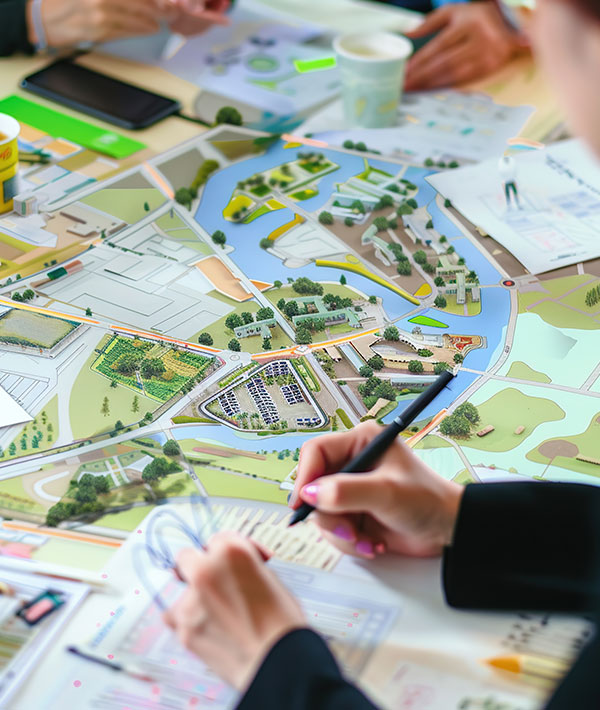
Planners working over a new-town master plan
04 · Growth & innovation

Master-planning new towns and future cities

As Mumbai, Bengaluru, and Delhi fill up, growth is moving to Tier-2 and Tier-3 corridors, industrial nodes, and greenfield cities.

What ULI changes

Advisory Services Panels can convene local and international experts so new centers are transit-oriented, compact, walkable, and economically viable from the first phase.

Technology-enabled planning and simulation
05 · Growth & innovation

Centers of Excellence for urban science

Zoning maps alone cannot run a city. Planning now needs PropTech, GIS, digital twins, and simulation.

What ULI changes

Centers of Excellence with universities and technology partners can test tools, incubate PropTech, and train planners who work from data rather than static regulations.

The path forward

Indian cities will not get there through separate projects. An Urban Land Institute would be the shared place where capital, technology, policy, and sustainability are decided together.

How can private developers and public agencies collaborate more effectively to build climate-resilient Indian cities?

Related work

#UrbanDevelopment #RealEstateIndia #SustainableUrbanism #PropTech #CityPlanning #ClimateResilience #ULI #FutureCities #IndiaGrowth